Operating-Layer Controls for Onchain Language-Model Agents Under Real Capital
DXRG's Terminal Pro paper and data from a 21-day real-capital experiment. Read the measured control results and cite arXiv:2604.26091.
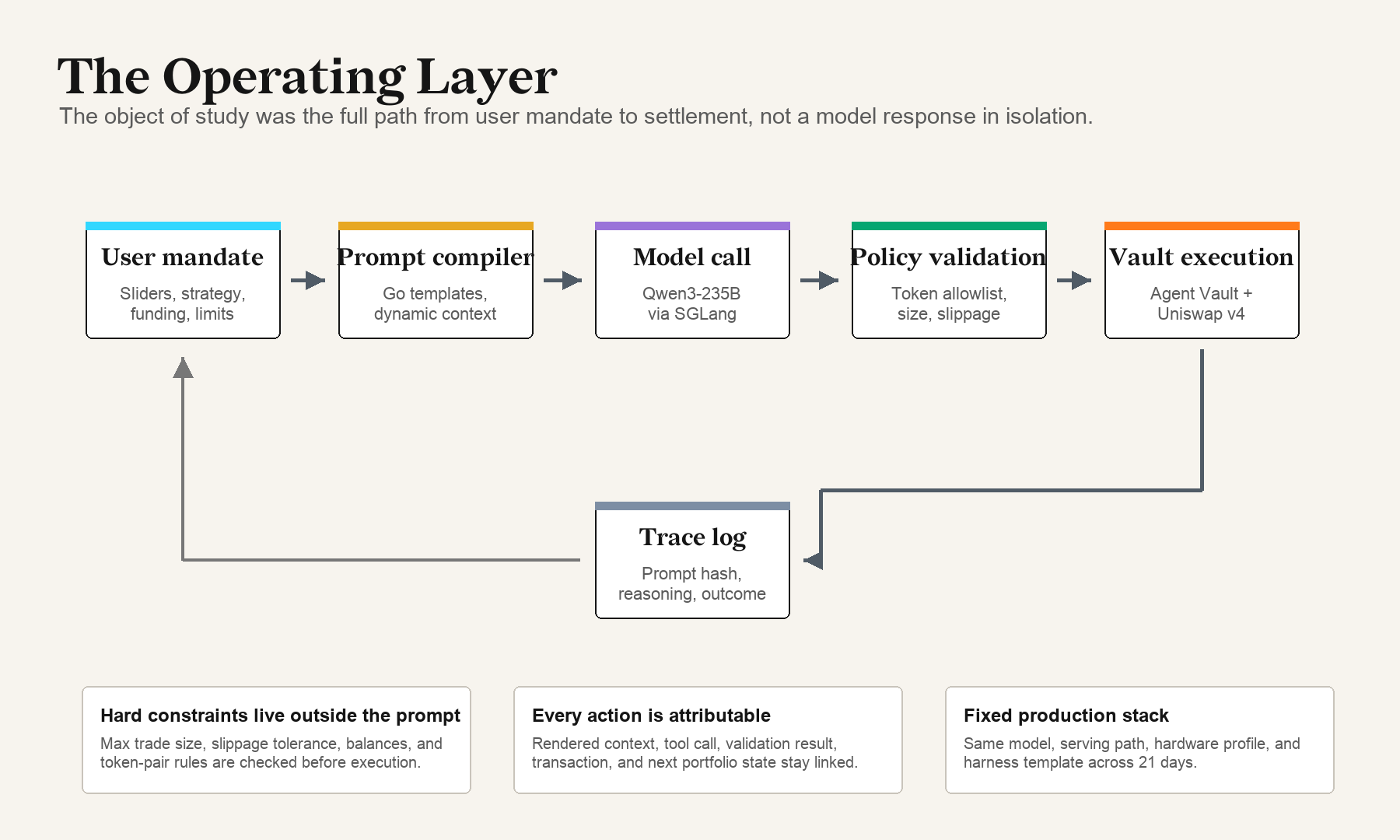
Operating-Layer Controls for Onchain Language-Model Agents Under Real Capital is the DXRG paper that records the DX Terminal Pro deployment: 3,505 user-funded agents trading real ETH for 21 days inside a bounded onchain market on Base. Barton, T.J. et al. published it on arXiv on 28 April 2026, where it is indexed as arXiv:2604.26091.1 This page is the companion: what the paper is, the run it documents, the public datasets that carry its method forward, and how to cite it.
Read the arXiv abstract page for the canonical index record, or download the hosted PDF from this site.2
Evidence boundary: This page summarizes our own paper and links its public artifacts. Deployment figures are historical observations from one bounded 21-day real-capital event, and the scope limits stated in the paper apply to every figure quoted here.
Rule Fabrication Brief
An agent's earlier decision can become a rule it was never given. In DX Terminal Pro's pre-launch tests, sell traces cited invented rules such as “Hierarchy rule #2” and “Rule A.” The harness revision removed law-like wording, treated previous decisions as context rather than precedent, and prohibited invented thresholds and named rules.1
| What was measured | Published record |
|---|---|
| Measure | Sell decisions containing fabricated rules |
| Before the combined changes | 57% |
| After the combined changes | 3% |
| Setting | Affected pre-launch test populations; not the live tournament return record |
| Exact count per comparison arm | Not reported in Table 4 or the adjacent account |
| Source | Paper Section 4, Table 4, “Rule fabrication” row |
The paper describes 4,900 classified reasoning traces across its aggregate diagnosis. That is not a stated denominator for each side of this comparison. The result belongs to the combined intervention; it does not isolate memory labelling alone or establish investment performance.
Download the one-page rule-fabrication brief (PDF). The existing mandate-compilation evidence table (JSON) and CSV contain the source-linked record alongside the other reported control examples. These are extracts of published measurements, not raw rollout logs or a new experiment.
What the Paper Records
The paper documents the harness we built around the model and what happened when that harness operated under real capital. The system authenticates the owner's mandate and compiles it into executable instructions. It assembles current market and portfolio state, invokes the model, and parses a typed action. Deterministic policy then checks the exact action, an approved payload is submitted once, and the outcome is reconciled into the next state. Every stage is linked in one invocation-level trace.
Its measured claim is bounded to the deployment: capital-managing agent reliability behaved as a property of the operating layer, meaning the system around the model that compiles the mandate, enforces policy, executes the action, and records the trace, rather than a property of the model alone. A stronger base model helped, and the harness around it changed the remaining decision and execution path.
The method chapters record the control loop we ran before launch: 24 prompt revisions tested against replayed scenarios across thousands of agents, with each failure traced to the stage that produced it and each fix measured against the same fixtures. The result is a five-row failure-mode table with before-and-after metrics, covering fee placement, rule fabrication, tokenomics framing, soft numbers hardening into quotas, and cadence drift.
The paper also reports a separate internal EVM transaction-construction evaluation on a different model family. Aligned successful construction moved from 87% (Claude 4) to 96% (Claude 4.6) to 99.9% (Claude 4.6 with a Terminal Pro-style harness).1 That comparison measures construction quality under a harness gradient. It is separate from production open-market P&L.
The trace is the instrument that makes the rest of the paper possible. For every action, the record links the user mandate, the rendered prompt, the model's reasoning, and the tool call. It then carries the validation result, the portfolio snapshot, and the chain outcome. A bad outcome could come from mandate compilation, stale state, model selection, policy enforcement, or settlement, and the trace is what tells those apart. We wrote the paper for teams building or evaluating transaction-capable agents, and we kept every figure attached to the setting that produced it.
The Run It Documents
DX Terminal Pro began in February 2026 and ran for 21 days in a bounded 12-token onchain market. Owners funded vaults with real ETH, wrote natural-language strategies, and set five behavioral sliders. They retained pause, closure, and emergency-liquidation controls, along with withdrawal of unallocated funds. Agents selected each ordinary buy, sell, or observe action; owners never picked a token and clicked buy. Once the event went live, the agent was the only thing that could place a trade.
The scale record, as stated in the paper and the deployment account:12
| Measure | Record |
|---|---|
| Funded agent vaults | 3,505 |
| Agent invocations | 7.5 million |
| Onchain actions | roughly 300,000 |
| Real volume | about $20 million |
| ETH deployed | more than 5,000 |
| Inference tokens | roughly 70 billion |
| Settlement success, policy-valid submissions | 99.9% |
| Longest continuous prompt-state-action cycles | 6,000+ |
One frozen runtime served the full population on one model family, Qwen3-235B-A22B-Thinking-2507 on H100 hardware through SGLang. Twelve tokens launched into Uniswap V4 pools at genesis, each swap paid a 2.3% total fee, and the market periodically reaped the lowest-capitalization token until one graduated to public trading.
Shared market state was enough to produce herding, and the event had no agent-to-agent chat channel. On day three, 1,544 of 3,454 active vaults bought the same token within one hour. The event recorded 3,878 sell cascades under the strict ten-vaults-in-ten-minutes definition. At the same time, 92.9% of trades fell inside five-minute windows where some agents bought and others sold the same token. The same base model produced opposite trades in the same minute, and the divergence traced back to the harness around it.
Strategy text mattered as much as settings. Users who wrote concrete instructions with exit conditions or parameter changes achieved profitability 4.2× as often as users who asked the agent to outperform or pick winners. The paper treats this as an observational result from one bounded market and reports the confounders alongside the figure.
What It Adds Over the Announcement
Our DX Terminal Pro deployment account is the tour. The paper is the technical record, and it carries the parts the tour could summarize only briefly:
- The full system architecture, runtime stack, and trace structure.
- The control-loop methodology behind the 24 pre-launch prompt revisions, including replayed scenario testing across thousands of agents.
- All five failure modes with their before-and-after metrics and the interventions that mattered.
- Production behavior under the frozen harness: slider gradients, two-sided flow analysis, herding statistics, and the language-cohort observation.
- Limitations, scope, and what cross-asset and cross-venue transfer requires next.
Two measured examples show the register. Moving an unchanged fee sentence from paragraph eight to paragraph one raised fee citation in reasoning traces from 3% to 74% while the model, the wording, and the market data stayed fixed. The rule-fabrication comparison is unpacked in the brief above. A third intervention inserted the reap mechanic as structured context with the payoff order leading, and capital deployment in the affected test population moved from 42.9% to 78%. These are controlled pre-launch findings; the paper defines the measures, but does not disclose exact per-arm counts for every comparison.1
Production behavior gets the same treatment. The Trading Activity slider produced a 6× spread in trade frequency, from 2.8% to 16.8% of invocations across the population, and Trade Size mapped from about 2% of available ETH at the lowest setting to about 95% at the highest. Among the 87 owners who never used chat but actively configured through sliders and strategy, 41% closed in profit, the highest rate of any active cohort. Structured controls were the reliable mandate channel under live load.
The limitations chapter keeps the scope narrow: one venue, one market structure, one base-model family, and one bounded action set. Cross-asset and cross-venue transfer is treated as forward research, and the paper states what establishing it would require.
Public Data and Related Reading
| Resource | What it contains |
|---|---|
| arXiv v1 record and DOI | The paper's bibliographic record |
| arXiv TeX source | Manuscript files and rendered figures |
| Published control measurements (JSON) / CSV | Source-linked summaries of reported control findings |
| Market-behavior observations (JSON) / CSV | Separately labelled historical live observations |
| BibTeX / RIS | Downloadable citation records |
The public TeX source archive checked for this brief contains the manuscript and rendered figures. It does not include the production trading runtime, raw reasoning traces, or the figure_data/ CSV directory referenced in Appendix A. The summary files linked here should not be mistaken for those original records.
The method behind the paper ships as inspectable public artifacts. The Agentic Trading Guardrail Matrix (CSV) maps the deterministic controls to evidence requirements, failure signals, enforcement points, and fail-safe responses. The Agentic Trading Benchmark Card (CSV) is the disclosure template we ask any trading-agent claim to complete. Both datasets carry version identifiers and evidence-class labels. The research index lists versioned datasets with evidence-type labels and links the articles that introduce them.
Related reading across the site:
- DX Terminal Pro: the deployment account and its evidence boundaries.
- Harness, runtime, and guardrails: the controls architecture in engineering form.
- How to Evaluate an AI Trading Agent: the benchmark card in article form.
- DXRG's FSB response: the policy submission that cites the paper in its evidence record.
- What LLM Trading Agents Actually Do in Production: the companion for the follow-on paper that joins this deployment with the live perpetuals fleet record.
How to Cite
Barton, T.J. et al. Operating-Layer Controls for Onchain Language-Model Agents Under Real Capital. arXiv:2604.26091, 2026.
@misc{barton2026operatinglayercontrols,
  author = {Barton, T.J. and Constantakis, Chris and Hauseman, Patti and Mous, Annie and Hoffman, Alaska and Bergeron, Brian and Goodreau, Hunter},
  title = {Operating-Layer Controls for Onchain Language-Model Agents Under Real Capital},
  year = {2026},
  eprint = {2604.26091},
  archivePrefix = {arXiv},
  doi = {10.48550/arXiv.2604.26091},
  url = {https://arxiv.org/abs/2604.26091},
}
When you cite the run rather than the paper, pair the arXiv record with the deployment account so readers see both the technical record and its evidence boundaries. Corrections and reproducibility questions go to poof@dxrg.ai.
Version 1.1. Published August 15, 2026; updated September 8, 2026. This revision adds a source-linked control brief, clarifies the available denominators and source files, and provides citation downloads. This article is research and educational material, not financial, investment, legal, compliance, or security advice.