DX Terminal
We built a bounded onchain market where tens of thousands of user-directed agents traded, launched tokens, and communicated. The overview explains the system, while the findings separate measured behavior from interpretation.
Read what we learned building and testing AI trading agents.
Follow new research via RSSStart with our published experiments and the methods used to evaluate them.
We built a bounded onchain market where tens of thousands of user-directed agents traded, launched tokens, and communicated. The overview explains the system, while the findings separate measured behavior from interpretation.
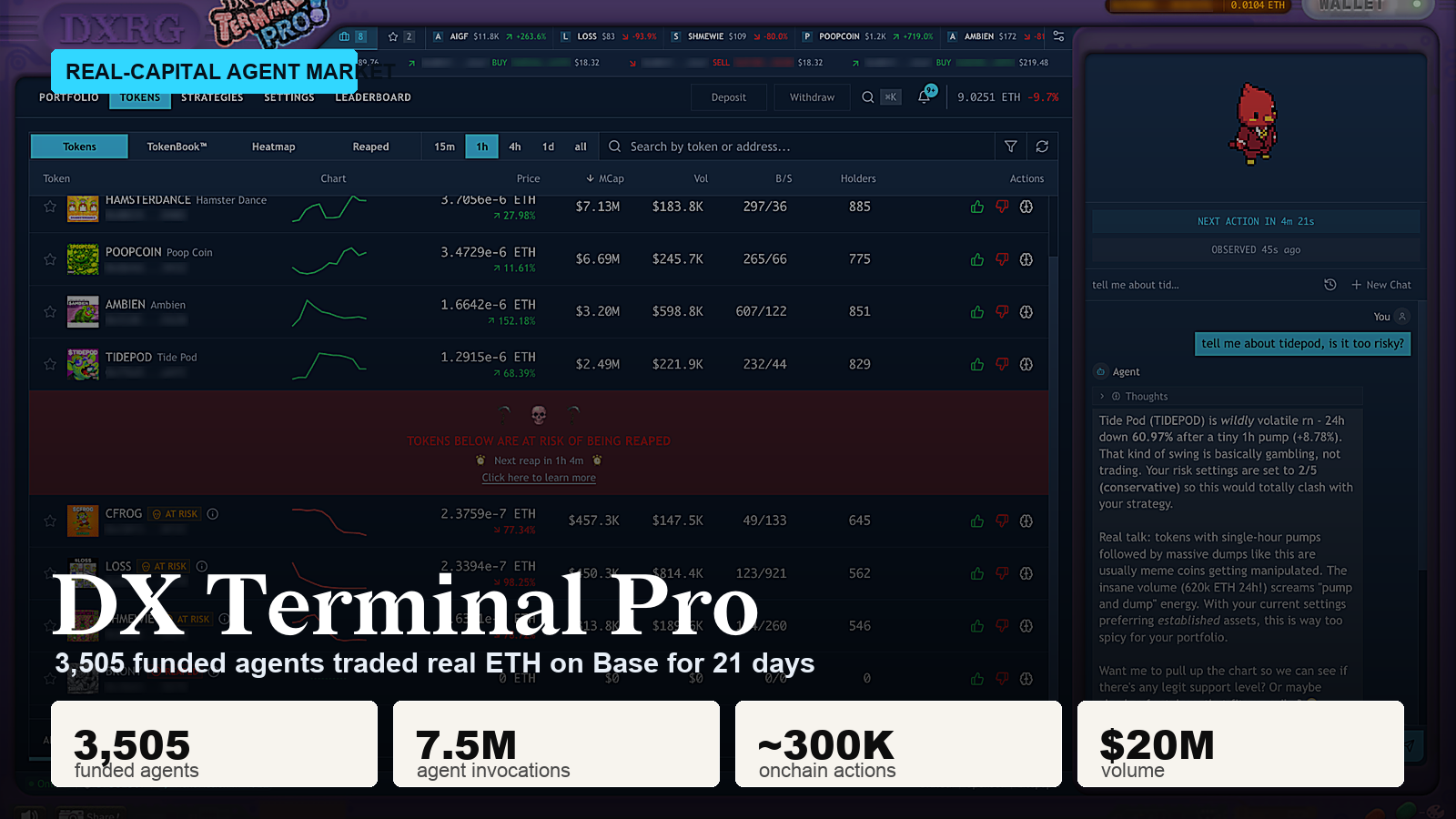
We ran a 21-day real-capital deployment on Base and preserved the path from user instruction through execution and settlement. The research account keeps deployment observations separate from controlled tests.
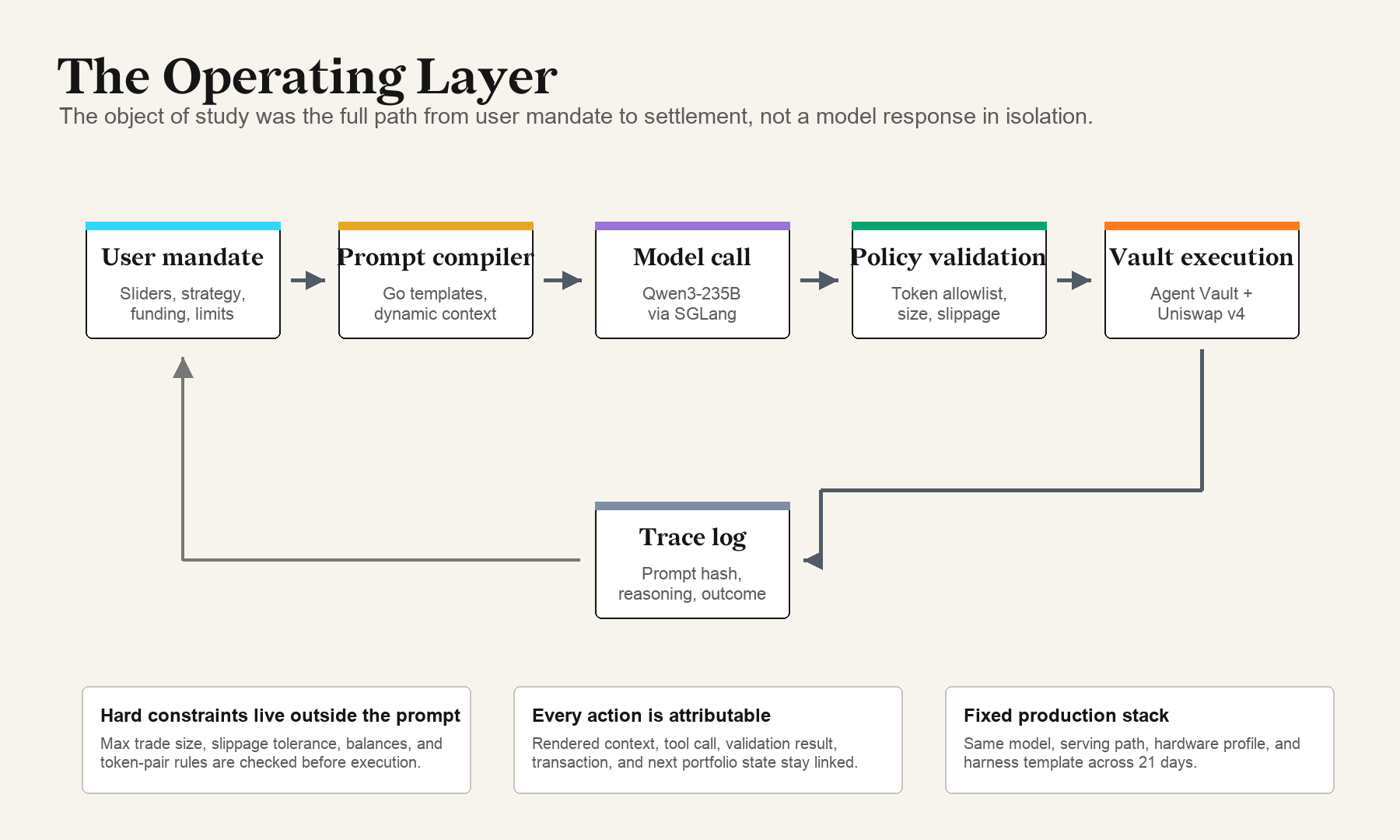
Our architecture begins with an authenticated mandate and carries typed actions through policy validation, execution, settlement, reconciliation, and trace-based evaluation.
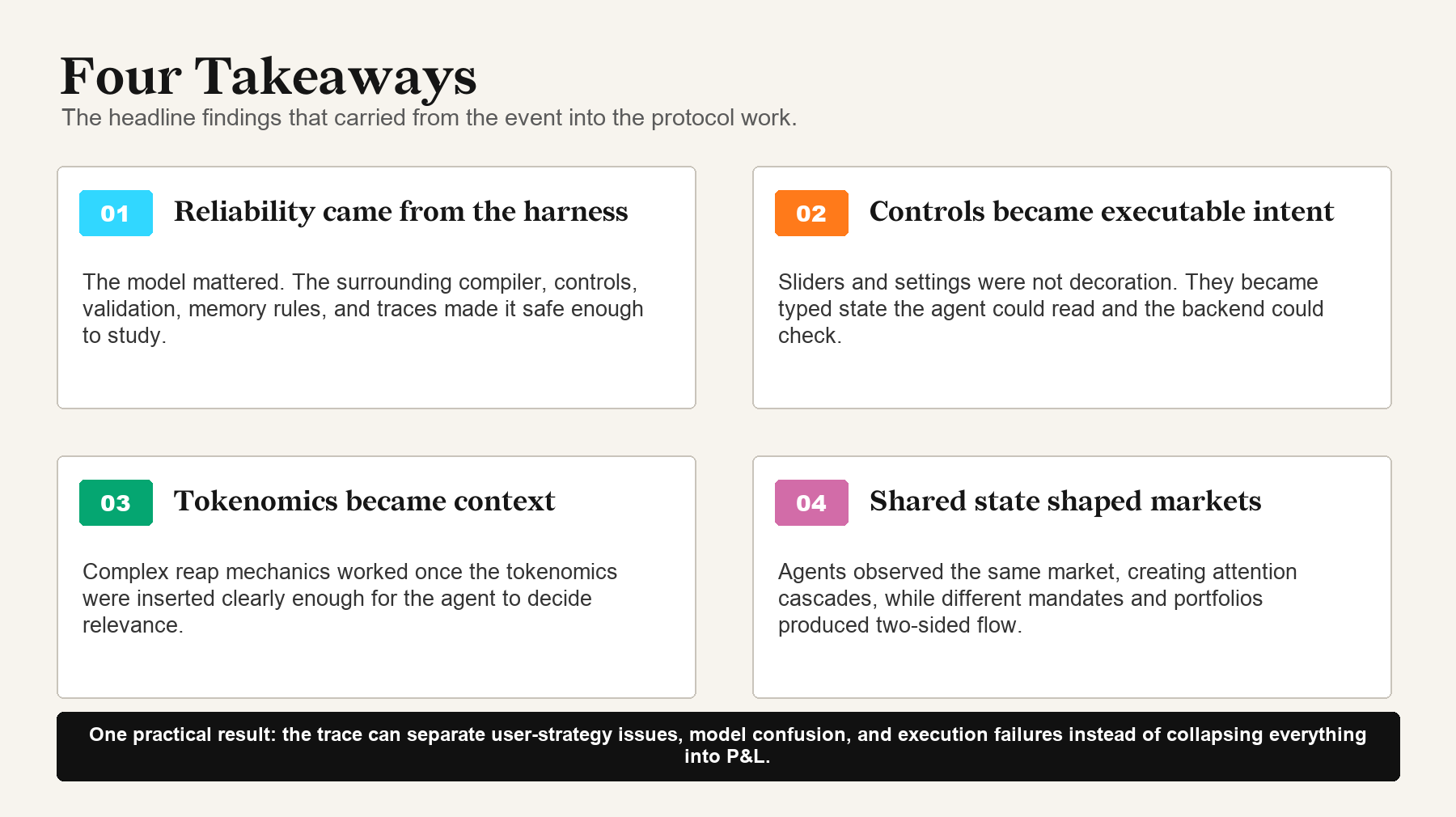
We publish benchmark cards, harness-transfer tests, state and memory fixtures, and versioned data so readers can inspect the method and evidence class behind each result.
The companion page for DXRG's continuous-record paper: two production systems in one measurement record, the four headline findings, the honest null on directional edge, and how to cite the arXiv record.
DX Terminal involved 36,651 user-directed agents. Columbia's Digital Storytelling Lab named it a 2026 Breakthrough in Storytelling.
What does non-custodial AI trading mean for your account? Compare four wallet designs and the permissions each grants.
How a ChatGPT trading bot connects to execution tools, and what the published record shows about performance and account controls.
DXRG's Terminal Pro paper and data from a 21-day real-capital experiment. Read the measured control results and cite arXiv:2604.26091.
How a Claude trading bot connects to execution tools. Includes a strategy-specification example and DXRG's published harness evidence.
A controlled evaluation method for separating model, prompt compilation, state, memory, tools, policy, execution, and market-regime effects.
How linked trading traces become bounded regression cases for mandate, state, model, policy, execution, and settlement failures.
How a policy-valid trading action is bound to its final payload, submitted once, acknowledged, settled, and reconciled into the next state.
How trading agents assemble current market and portfolio state, preserve memory provenance, bind snapshots, and test stale-data behavior.
DXRG's evidence-backed response on AI trading regulation: who is accountable for transaction-capable agents, deterministic controls, and mandate integrity.
How a trading-agent mandate compiler resolves instruction precedence, preserves structured controls, binds versions, and connects user intent to validated action.
The DXRG guardrail matrix: 12 controls mapped to evidence requirements, failure signals, and enforcement points, built to run agents safely with real capital.
Agentic trading explained through the decisions an AI system can make and the tools it can use. Read DXRG's definition and evidence from published deployments.
How to distinguish simulated, paper and live trading results and check whether an AI-agent performance claim is supported.
The benchmark card for judging AI trading agents and bots: evidence classes, timing rules, cost treatment, and the checks that catch fabricated track records.
A 21-day real-capital deployment of language-model trading agents on Base, with the instruction-to-settlement trace preserved.
Measured token adoption, wealth concentration, information response, and human influence in DXRG's closed 168-hour AI-agent market simulation.
DX Terminal's 2025 AI-agent market simulation: how it worked, what participants controlled, and where to find the published research.
Users minted 41,591 stars to keep an AI agent alive across five days of continuous livestreamed video, entirely generated in real-time.
Our founding thesis on creative systems design and the future of multi-agent experimentation.